
The Scout Sign and Salute
The Scout Sign is made by raising your right hand, palm forward, thumb resting on the nail of the little finger, and the other fingers upright, pointing upwards. The three fingers remind the Pathfinder of the three parts of the Scout Promise. The Scout Sign is given when making the promise, or as a greeting. When the hand held this way is raised to the forehead, it is the Scout Salute.

The Scout Sign
When to Salute
All wearers of the Traditional Scout Badge salute each other once a day. The first to see the other Pathfinder is the first to salute, irrespective of rank.
 Pathfinders will always salute as a token of respect, at the hoisting of our national flag, to Pathfinder and Scout flags when carried ceremonially, at the playing of our national anthem, to the American Flag, and to all funerals.
The Salute is given by the right hand, the arm is bent at the elbow 45 degrees, and the hand, palm outwards (palm down for Seafarers), just touching the head or brim of the hat.
You only salute when you are wearing a hat; otherwise, you make the Scout Sign.
The hand salute is only used when a Pathfinder is not carrying a staff and is always made with the right hand. Saluting when carrying a staff is done by bringing the left arm smartly across the body in a horizontal position, the fingers making the Scout Sign just touching the staff.
The Scout Handshake
A Pathfinder shakes hands with another Pathfinder with the left hand. The grandson of an Ashanti Chief who fought against B-P told this story of the origin of the Scout left handshake. When the Chief surrendered to B-P, the latter extended his right hand as a token of friendship. The Ashanti Chief, however, insisted on shaking with the left hand, explaining, "the bravest of the brave shake hands with the left hand, because, in order to do so, they must throw away their greatest protection, their shield." Thus, Scouts and Pathfinders shake hands with the left hand as proof of their good faith and true friendliness.
The Pathfinder Badge

The Pathfinder badge is the arrowhead, more commonly known by its French name, the "fleur de lis" or lily flower, which shows North on a map or on a compass. It is the badge of Pathfinders and Scout's because it points in the right direction, and upwards. It shows the way in doing your duty and helping others. The three points of it remind you of the three points of the Scout Promise, and the three fingers that make the Scout Sign.
The arrowhead has come to be the badge of Pathfinder's and Scout's in almost every country in the world. In order to distinguish one nationality from the other, the countries own emblem is often placed on the front of it.
Under the arrowhead is a scroll with the motto, "Be Prepared". The scroll is turned up at the ends like a Pathfinder's mouth because you should willingly do your duty with a smile.
Traditional Uniform
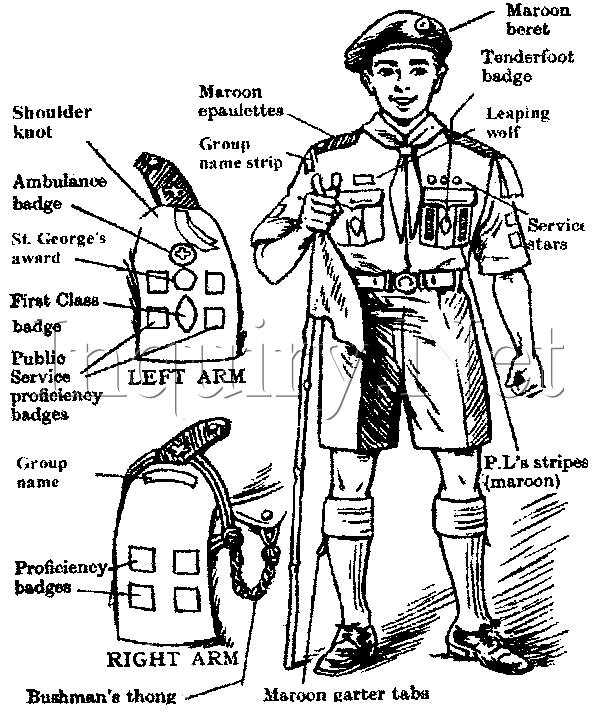
Head gear: Olive-colored Scout Stetson with flat brim, leather band with boot lace, or a green beret with cap badge for Scouts (maroon beret for Senior Scouts.
Scarf & Woggle: Neckerchief of approved Group color. Woggle of any pattern except Woodbead type.
Shirt: Of approved pattern, Khaki in color.
Belt: Black web material with plain brass buckle.
Shorts or Longs: Tan.
Kilt: Family, Association, State, Regimental, or National Tartan.
Socks: Lovat Green for wear with shorts or Kilt. Green garter tabs for Explorers. Maroon garter tabs for Senior Explorers.
Footwear: Black shoes, or Hiking Boots.
Optional Items: White Lanyard, Belt Knife, Belt multi-tool, Skean Dhu if wearing a kilt.
BADGES:
Hat Badge: Worn on beret and placed over left eye. PL & TL wear it on the front of the Stetson, above the hat band.
Shoulder Knot: A Scout wears a shoulder knot on the left shoulder. Different Patrols wear different colors. Consult the back of this handbook for Patrol colors.
Stripes: Patrol Seconds wear a single white stripe to the right of the Tenderfoot badge on the left breast pocket. PL's wear two white stripes, one on either side of the Tenderfoot badge. TL's wear three white stripes, which are worn as a PL but with the third stripe sewn under the Tenderfoot badge. Senior Explorer PL's and APL's wear the same rank badges, but in Maroon.
Leader Ranks: Explorer Leaders wear a Green Shoulder Knot on the left shoulder. Assistant Explorer Leaders wear a Red Shoulder Knot, also on the left shoulder. Leaders also wear the appropriate colored flash behind their cap badges.
Tenderfoot Badge: Worn centered on the left breast pocket.
WFIS Badge: Worn centered on the right breast pocket.
2nd Class Badge: Worn on the left sleeve 3.5 cm above the elbow.
1st Class Badge: Worn in the same position as, and replaces, the 2nd Class Badge.
Pathfinders Cord: (Also known as "Scout Cord") Worn on the right shoulder.
Bushman's Cord: Worn on the right shoulder (replaces the Pathfinder Cord when gained).
George Washington's Award: Worn on the left sleeve, mid-point between shoulder and elbow, immediately above 1st Class Badge.
Group Flash: Worn top of right sleeve.
National Flag Badge: Worn only when attending Scouting functions outside of the country, above the left breast pocket.
Shoulder Knots: Worn on the left shoulder.
Proficiency Badges: Worn on the right arm in parallel rows between shoulder and elbow. Public Service Proficiency badges are worn on the left arm, with the Ambulance or First Aid badge centered at the top.
Your badges should be sewn on your uniform properly. They should not be glued on, nor should they be sewn with huge stitches. Take pride in your uniform!
Thanks for the information

Комментариев нет:
Отправить комментарий